People often ask me why I give so much time to the IAMCP. The honest answer? Because being part of this community has made me sharper at every other thing I do.
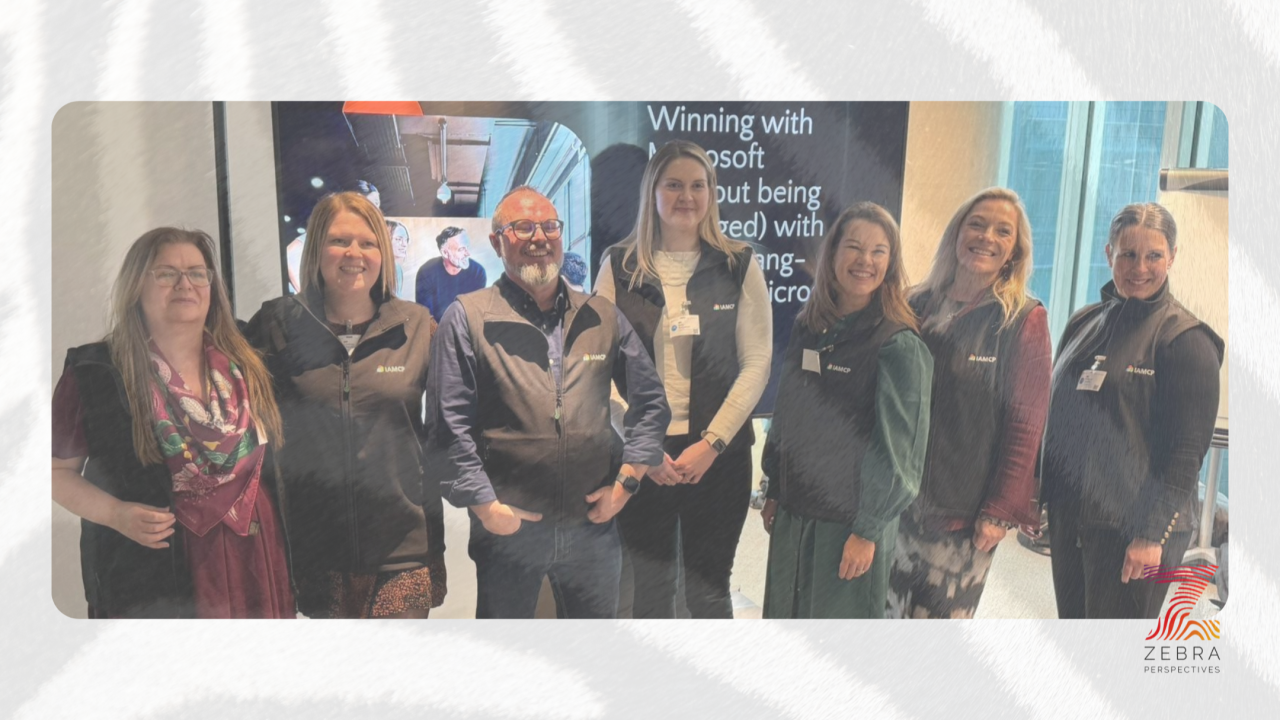
I’m President of the IAMCP UK&I chapter, the International Association of Microsoft Channel Partners. It’s a volunteer role within a much larger international network, and I’m fortunate to lead a fourteen-strong board of people who are every bit as committed to the Microsoft partner community as I am. No salary, no bonus, just a shared belief that connection, education, and advocacy matter. Together, we grew the chapter’s membership by 25% last year, achieved a 10.6% LinkedIn engagement rate well above industry benchmarks, and built a programme of events and channels that partners are actively choosing to show up for, month after month.
What being part of running all of that has reinforced for me is this: the fundamentals of a thriving membership community and the fundamentals of a great client/agency relationship are almost identical.
Let me explain. (Click the gallery below for the TL:DR version)




1. Structure Isn’t Bureaucracy — It’s a Foundation
When you’re leading a volunteer organisation, you can’t rely on hierarchy or job descriptions to keep things moving. People have day jobs and competing priorities. What keeps the engine running is structure: monthly meetings with clear agendas, follow-up notes, a shared calendar, defined roles. A rhythm the whole team can rely on regardless of what else is on their plate.
Our fourteen board members, all with demanding roles across the Microsoft partner ecosystem, are the living proof of concept. Each one brings something different; what holds it together is the framework. Take that away and you’re relying on goodwill and good intentions, which aren’t enough when everyone is busy.
That kind of discipline translates directly to great client work.
A strong agency/client partnership doesn’t run on goodwill either – it runs on rhythm. Regular structured meetings, a shared planning cycle, clear reporting cadences. These aren’t administrative overhead; they’re the assurance framework. They keep everyone on the same page and ensure there’s one agreed, consistent voice rather than competing versions of the truth.
When that structure breaks down, so does trust. I’ve seen it in membership organisations and I’ve seen it in client accounts. The fix is always the same: re-establish the rhythm.
2. Communication Is a Strategy, Not a Task
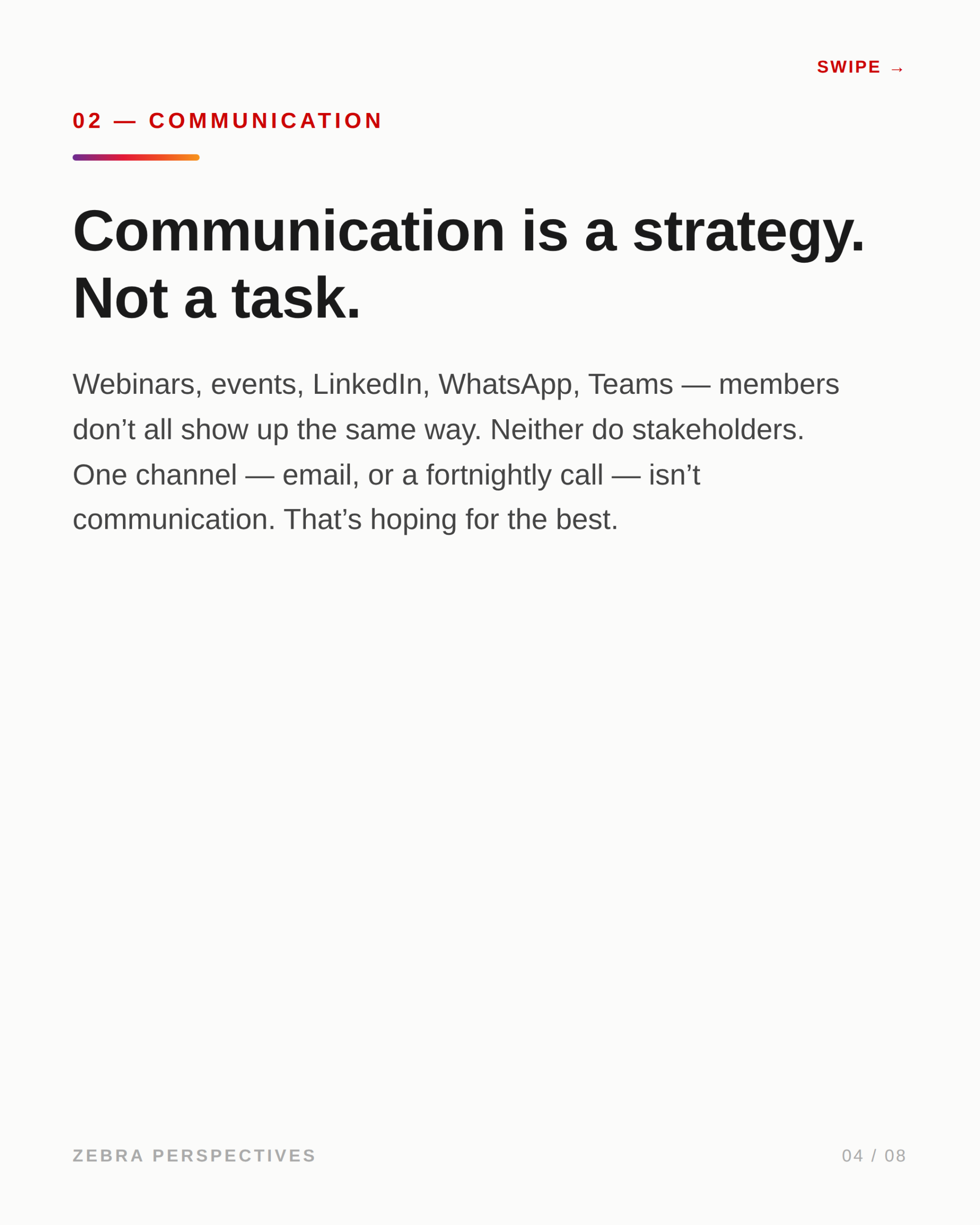
The IAMCP UK&I chapter runs monthly Connect & Thrive webinars, twice-annual in-person Partner Exchange events, regular education sessions, a members-only LinkedIn group, a WhatsApp chat, and a Teams channel. That’s not overengineering, it’s intentional.
Members don’t all consume information the same way. Some will read every email. Others will only engage if something lands in the WhatsApp group first. Some need to be in the same room as someone to feel genuinely connected. You reach people where they are, or you don’t reach them at all. The chapter’s 25% membership growth this year is partly a reflection of showing up consistently across multiple touchpoints.
The same logic applies to B2B marketing. Too many client relationships rely almost entirely on one channel, usually email or a fortnightly Teams call. That’s not communication. That’s hoping for the best.
A hybrid approach, online and in-person, formal and informal, scheduled and reactive, keeps stakeholders genuinely informed. And when everyone is informed, you spend less time managing misalignment and more time doing good work.
3. Feedback Is How You Stay Relevant
IAMCP UK&I isn’t a new community, it has a long history of bringing Microsoft channel partners together. But the board has deliberately evolved the chapter in recent years, using Microsoft’s global partner restructure as both an impetus and an opportunity. As the corporation shifted towards deep relationships with a select group of partners, many in the wider ecosystem found themselves with less direct support and guidance. We leaned in, re-energising the programme, building new touchpoints, and sharpening our focus on education and advocacy.
That pivot was only possible because the community was already listening. Closely.
A community that stops listening to its members doesn’t die loudly. It just quietly loses renewals.
The same is true of agency/client relationships. The best consultants aren’t at arm’s length — they’re embedded at multiple touchpoints across marketing, sales, and leadership. Not for the sake of visibility, but for context. When you’re part of the real conversation, you hear what’s shifting in real time. You adapt before you’re asked to. You give counsel that’s grounded in the business today – not a strategy built on last quarter’s brief.
Feedback shouldn’t be a quarterly review or an end-of-campaign survey. It should be continuous, and it should change how you work.
4. Global Lens — The Skill of Stepping Back
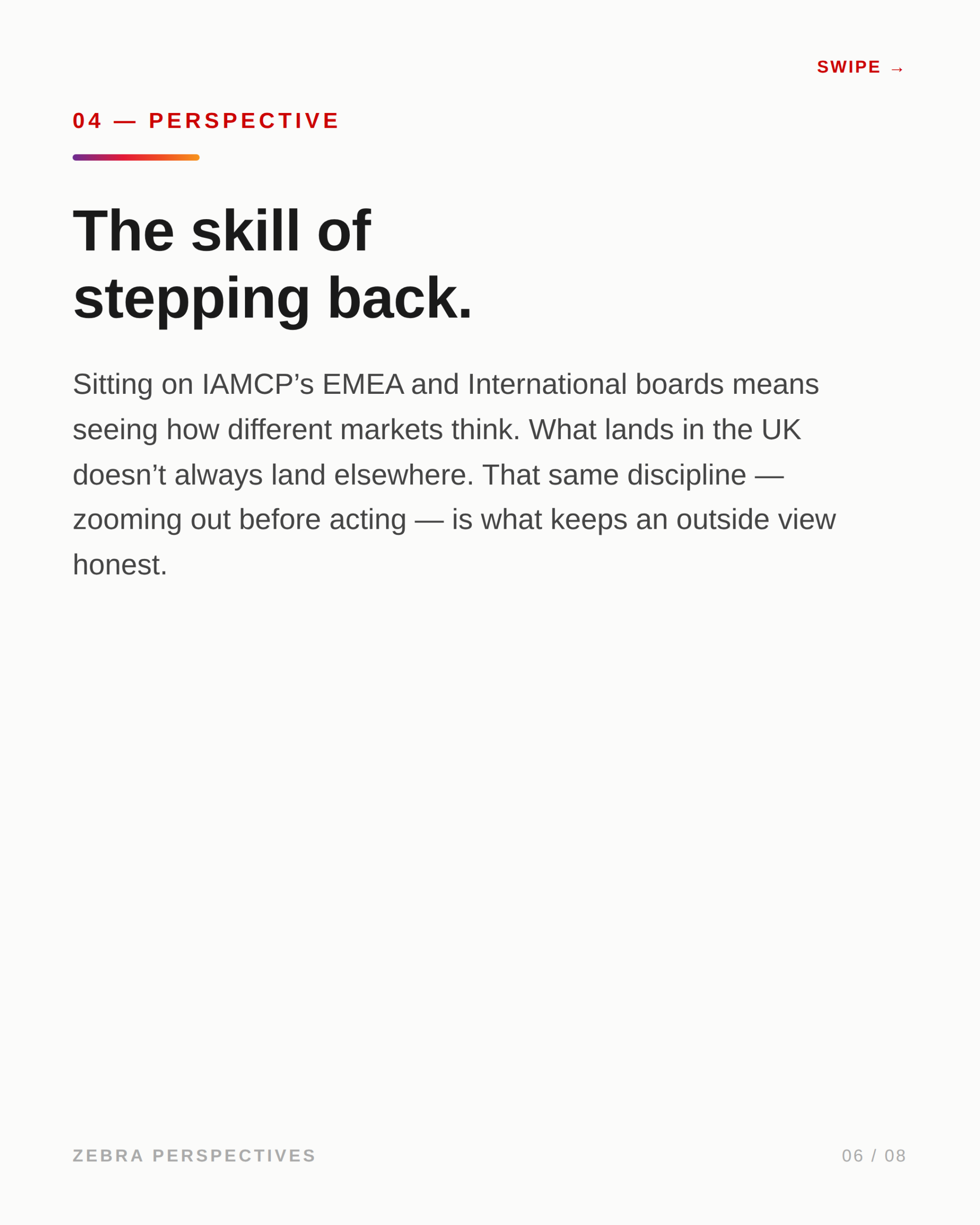
One of the privileges of sitting on the IAMCP EMEA and International boards alongside my UK&I role is the exposure it brings. I get to learn from peers and leaders across multiple markets, different partner landscapes, different Microsoft priorities, different cultural and commercial contexts. It’s a genuinely valuable vantage point, and one I couldn’t get anywhere else.
For a global membership organisation, that breadth is a constant reminder: you cannot assume your audience thinks, operates, or prioritises the way you do. Geographic spread demands conscious, deliberate communication. What lands in the UK doesn’t always land in Germany. What’s urgent in the US might be background noise elsewhere. You have to step back and ask: who are we actually talking to, and where are they?
That instinct – the discipline of zooming out before acting – is one of the most valuable things I bring to client work.
It’s also fundamental to what Zebra Perspectives is. Being embedded in a client’s business is a strength; it means real context and genuine partnership. But you have to hold onto enough independence to see what they can’t see from the inside. The external perspective. The wide view. The ability to step back from the day-to-day and ask: is this landing the way we think it is?
That’s the value of an objective eye. And it’s something you only develop if you’re actively training it — which, it turns out, working alongside sharp people across an international volunteer network does rather well.
The Through-Line
Structure, communication, feedback, perspective. These aren’t soft skills or nice-to-haves. They’re the operational backbone of any high-performing relationship, whether that’s 247 members trusting our chapter and its board to represent their interests in the Microsoft ecosystem, or a client trusting you with their brand and their budget.
Volunteering hasn’t been a distraction from my consultancy work. It’s been a live, constantly evolving lesson in everything I believe great B2B marketing looks like in practice, and much of that learning has come from the people I get to work alongside.
So here’s my challenge: if you’re a marketing consultant or agency lead, when did you last honestly audit the health of your client relationships against these four pillars? Not the quality of the work — the quality of the partnership.
Because the work is only as good as the relationship behind it.