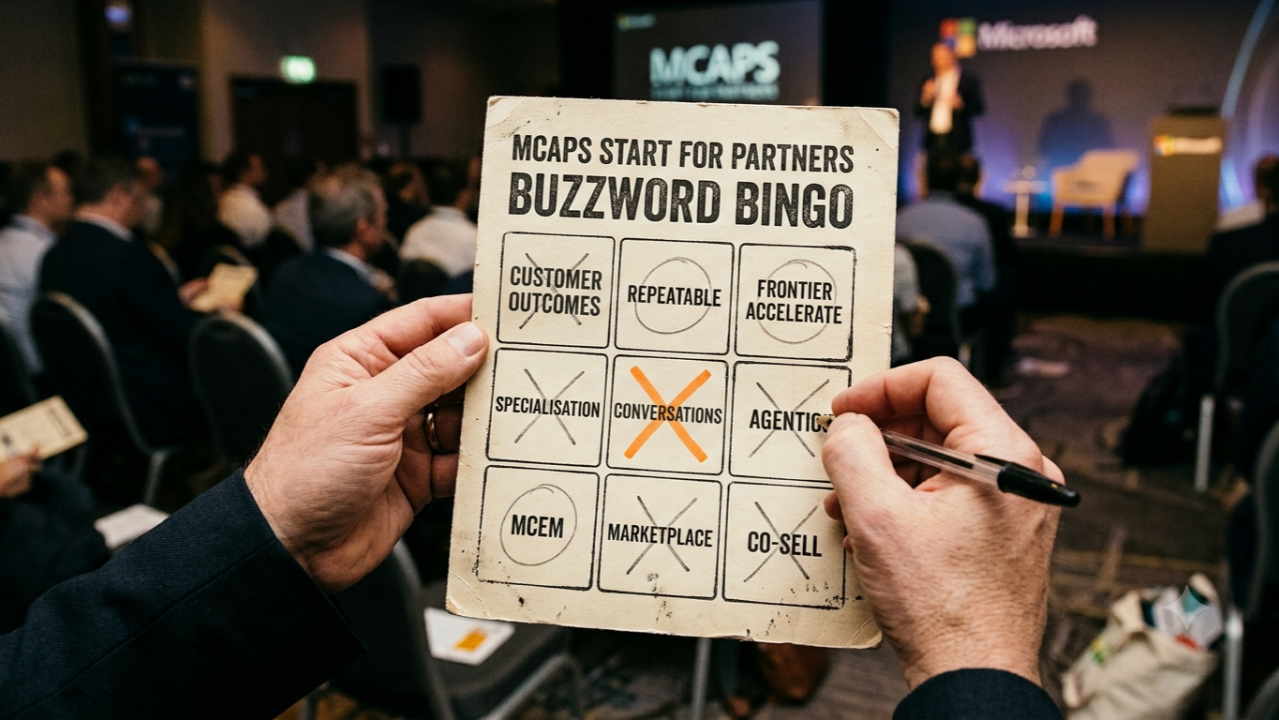
Most of the post-event coverage from MCAPS Start for Partners FY27 is focused on the same things: the incentive structures, the new Frontier Partner specialisation, the Agentic Security designation, the Frontier Accelerate programmes. All of it is relevant and worth understanding, but if you only read the programme updates, you missed the most important signal Microsoft sent last night.
It was a word.
From “Solution Plays” to “Conversations”
Across every slide, every session, every GTM framework presented at MCAPS Start, Microsoft has retired one piece of language and replaced it with another.
“Solution Plays” are gone.
“Conversations” is the FY27 framework.
The Enterprise and Corporate GTM is now structured around “Frontier Conversations” and “Core Conversations.” The SMB GTM is built around “Conversations.” The entire go-to-market motion has been reframed around business outcome dialogues, not product or solution motions.
This is not terminology housekeeping. It is a fundamental repositioning of what Microsoft expects a partner to do when they walk into a customer meeting.
A solution play starts with what you sell. A conversation starts with what the customer needs.
The practical implication for partner marketing is significant: every website, every campaign, every piece of sales collateral that was built around “our solutions include…” is now misaligned to how Microsoft’s field is framing the customer engagement. Partners who want to co-sell effectively in FY27 need to speak the same language — and that language is now outcome-led, conversation-first, and business-process-specific.
“Advise” now leads the partner value chain
Look carefully at how Microsoft described who it is recognising through the new Frontier Offers framework:
“Recognising partners who advise, build, manage and secure agents to drive Frontier Transformation.”
Advise. Listed first. Before build. Before manage. Before secure.
This is the first time Microsoft has formally placed the advisory capability ahead of technical delivery in its partner recognition framework. For years, the programme has rewarded partners primarily for what they deployed, activated, and consumed. The shift to formally recognising the advisory, consulting, and envisioning role that partners play is material – and it has direct implications for how partners with consulting, change management, or AI envisioning capability should be marketing themselves.
If your marketing leads with your technical accreditations and delivery track record but never describes your advisory approach, your AI envisioning methodology, or your change management capability, you are leaving your most newly-valued asset invisible.
Co-selling: Microsoft is doubling down on “Listen and Consult”
MCEM has always started with Listen and Consult, that is not new. What was notable at MCAPS Start was the degree of emphasis Microsoft placed on those two early stages, and the explicit ask for partners to engage with Microsoft earlier in the customer journey, before a defined lead exists.
The message was direct: do not wait until you have an opportunity to bring Microsoft in. Engage earlier, in the consultative stages, and use MCEM as shared language across the partner and Microsoft field relationship. The slide framed it clearly: “Propensity signals point to the Conversation; your solution and services deliver the outcome.”
The conversation comes first. The solution follows.
This matters because it signals Microsoft recognises that AI transformation is a more complex, longer-cycle sell than a traditional software deployment. Customers need to be listened to and consulted before they are sold to. Partners who show up with a consulting posture, not a pitch, are the ones Microsoft wants alongside them in those early conversations. The practical implication for partner marketing is significant: if your content, your campaigns, and your sales approach are built around responding to leads rather than creating consultative engagement, you are missing where the FY27 co-sell motion actually begins.
Industry expertise and business process knowledge are the new differentiators
The specific language Microsoft used in the GTM framework is worth examining closely. “Agentify your business process.” “Scale business processes with agent-powered finance.” “Build a unified, governed data and AI estate.” These are not technology messages, they are business process messages.
Microsoft is signalling that the partner conversations it values most are the ones grounded in deep understanding of how specific industries operate and how business processes can be redesigned with AI. Generic AI implementation capability is table stakes. Industry expertise and business process knowledge are the differentiators.
For partner marketing, this is both a challenge and a significant opportunity. Partners who have vertical depth or business process expertise, often hard-won over years of customer delivery, frequently do not market that depth clearly. They describe themselves in technology terms when their real value is operational and industry knowledge. FY27 is the year to fix that.
Net new customer acquisition is back on the agenda
One further signal worth noting: Microsoft has explicitly incentivised net new customer acquisition in FY27, not just upsell and renewal. “Accelerate growth to earn higher rewards through upsell and net new customer acquisition to the ecosystem.”
For many Microsoft partners, new customer marketing has been a lower priority than retaining and expanding existing accounts. The financial incentive structure is now shifting to reward new logo acquisition. That means demand generation — the ability to create pipeline from net new prospects — is moving back to the top of the partner marketing agenda.
What this means for partner marketing in FY27
Taken together, the signals from MCAPS Start paint a consistent picture: Microsoft is raising the bar for what it considers a well-positioned, co-sell-ready partner. The bar is no longer technical accreditation alone. It is the ability to have business transformation conversations, demonstrate advisory capability, articulate industry expertise, and generate net new demand.
The partners who will close the gap fastest are the ones who treat this as a marketing challenge, not just a delivery challenge. The narrative needs to change before the sales motion can change.
The message from MCAPS Start is clear: partners need to think beyond campaigns and focus on how marketing contributes to customer transformation and business outcomes.
If your marketing strategy, messaging, or content still reflects yesterday’s conversation, now is the time to reassess it.
Need help aligning your marketing with Microsoft’s evolving FY27 priorities? Contact Zebra Perspectives to explore how we can help your organisation build a more strategic, differentiated, and Microsoft-aligned marketing approach.