Previously Deidre Jones unpacked Judson Althoff’s message to partners: managed services are your AI superpower. The channel is no longer a distribution layer, it’s the operating layer for enterprise AI, and the partners who build around that will define the top tier of the ecosystem in FY27.
Now there’s a second signal worth reading carefully.
Cyril Belikoff’s latest partner blog “From planning to execution: FY27 priorities for cloud and AI partners” looks, on the surface, like a familiar pre-fiscal-year roundup. AI priorities, Marketplace updates, programme investments, key dates. The kind of post partners skim, forward to their alliance team, and file away. That would be a mistake. Read it closely and a different message emerges, one that has significant implications for how Microsoft partners think about their go-to-market strategy, not just their technical delivery roadmap.
The shift hiding in plain sight
The title says it all, if you’re paying attention: From planning to execution. FY26 gave partners time and space to experiment.
Microsoft provided frameworks, ran pilots, and extended patience as the partner ecosystem found its footing with AI. That phase is over. FY27 is about execution at scale, and Microsoft is starting to distinguish between partners who are ready to execute and partners who are still figuring out their position. You can see it in the language Cyril uses throughout the post. Partners are invited to “align your go-to-market motion,” to “plan your next steps,” to “carry momentum into FY27.” These phrases are not enablement, they are expectation.
The assumption embedded in every sentence is that partners already understand where they fit, what they’re selling, and how they create customer outcomes.
The blog is not explaining the opportunity, it is telling you to act on it.
For partners whose marketing and GTM strategy hasn’t kept pace with their technical capabilities, this is a gap that is about to become very visible.
Why this matters for partner marketing specifically
Microsoft’s FY27 investments – the Frontier Partner Specialisation, the expanded Marketplace, the Frontier Engineer Badge, the Agent 365 control plane – are all designed to make it easier for Microsoft’s field team to identify and sell with the right partners. Faster. With less friction. The operative word is identify. Microsoft is building infrastructure to surface aligned partners quickly.
The question every partner marketing team should be asking is: when Microsoft’s field looks for a partner to co-sell with in your solution area, will they find you immediately and will what they find be compelling? Most won’t be. Not because they lack capability, but because their positioning hasn’t caught up with where Microsoft is heading.
This is the core partner marketing challenge of FY27:
- the gap between what partners can deliver and what they can clearly articulate has never been more consequential. In a year when Microsoft is filtering partners by execution readiness, a strong delivery capability with weak market positioning is no longer a minor inefficiency, it’s a competitive disadvantage.
MCAPS Start and GTM Kickoff: not just content sessions
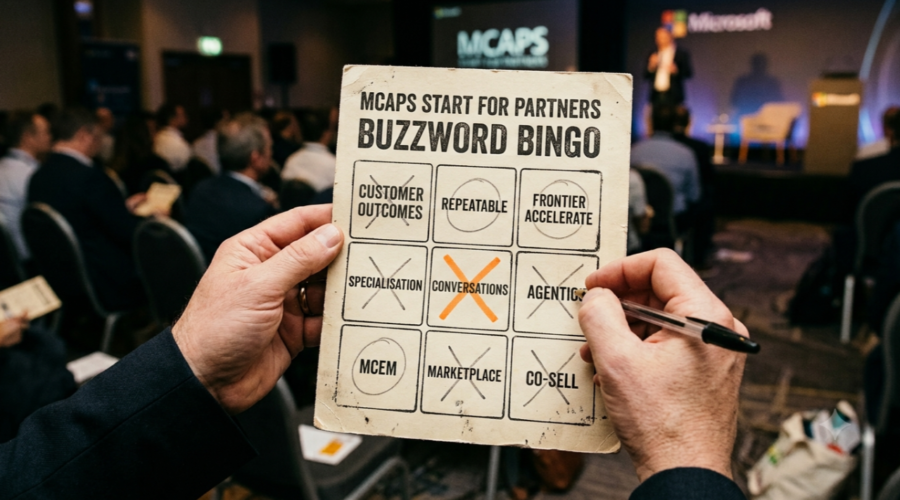
Cyril’s post points to two events every partner should treat as strategic milestones: MCAPS Start for Partners 22 July 2026 FY27 GTM Kickoff 28 July 2026. The default partner response to these events is to register, attend, extract the key themes, and update the slide deck. That misses the point. These are GTM alignment checkpoints. They signal where Microsoft’s field investment will concentrate, which solution plays will be co-sell prioritised, and which partner narratives will resonate with Microsoft account teams.
Partners who attend and walk away with a clearer view of those signals, and move immediately to align their messaging, campaigns, and offers accordingly, will have a measurable head start over those who treat the sessions as optional content. The window between these events and when Microsoft’s field begins FY27 customer conversations is short. Partners who show up already aligned don’t have to catch up. That matters when Microsoft is choosing who to sell with.
What partner marketing teams should do right now
The practical implication is straightforward, even if execution is not. Before July 22, partners should stress-test their positioning against a simple question: does our current market messaging reflect where Microsoft is going in FY27, or where we were twelve months ago? If the answer is the latter, the next two weeks are the time to fix it, not after MCAPS Start, when everyone else is also updating their content. After 22 July, the priority is speed to market. The partners who turn MCAPS signals into updated campaigns, refreshed website positioning, and customer-ready conversation guides within days, not weeks, are the ones who arrive in FY27 conversations already in context with Microsoft’s field priorities.
Specifically, partner marketing should be focusing on three things:
- Clarity of role in the customer lifecycle. Microsoft’s Frontier Transformation framework is explicit: partners create value across enriching employee experiences, reinventing customer engagement, reshaping business processes, and accelerating innovation. Partners who position around one of these with specificity, not “we help customers with AI,” but “we help manufacturing businesses embed AI into their supply chain operations and govern it at scale.” are the ones that will cut through in an increasingly crowded market.
- Execution narrative, not possibility narrative. FY26 messaging was built around what AI could do. FY27 messaging needs to be built around what your organisation actually delivers e.g: measurable outcomes, repeatable methodologies, named customer results. The shift from possibility to proof is where partner marketing has the most work to do.
- Microsoft alignment made obvious. Cyril’s blog covers Frontier Partner Specialisation, Agent 365, Microsoft Marketplace multiparty offers, and the Frontier Engineer Badge. Partners pursuing these programmes should be making that visible in their marketing, not as credential-dropping, but as evidence of the investment they’ve made in delivery readiness. Microsoft’s field looks for signals of alignment. Partner marketing should be generating those signals consistently.
The Zebra Perspectives take
Judson Althoff told partners where the long-term value is: managed services, ongoing governance, trusted operating partnerships. Cyril Belikoff is now telling partners how Microsoft will be evaluating them: by whether their go-to-market reflects that ambition, not just their delivery capacity. FY27 won’t expose capability gaps in most of the partner ecosystem; the capability is there; but what FY27 will expose is the gap between what partners can deliver and how clearly they can tell that story in the market. That is a partner marketing problem. And it is one that can be addressed, fast, with the right focus.
At Zebra Perspectives, this theme is running through every client conversation we’re having right now. The partners who will win disproportionately in FY27 are the ones who treat their marketing and GTM strategy as part of their Microsoft programme execution, not a separate workstream that runs behind it.
If you’re preparing for MCAPS Start on July 22 and want a practical framework for turning what you learn into an aligned GTM motion, we’ve put together a combined FY27 Partner Marketing Checklist and GTM Alignment Guide. Drop a comment below or connect with us directly and we’ll send it across.